
About 20% of the entire room air conditioner market is portable air conditioners. Even though there are plenty of portable air conditioners on the market, choosing the right one can be difficult. To help consumers make an informed choice, we have evaluated 20 air conditioners to assess their performance. Although we found performance differences among some portable air conditioners, there were many similarities.
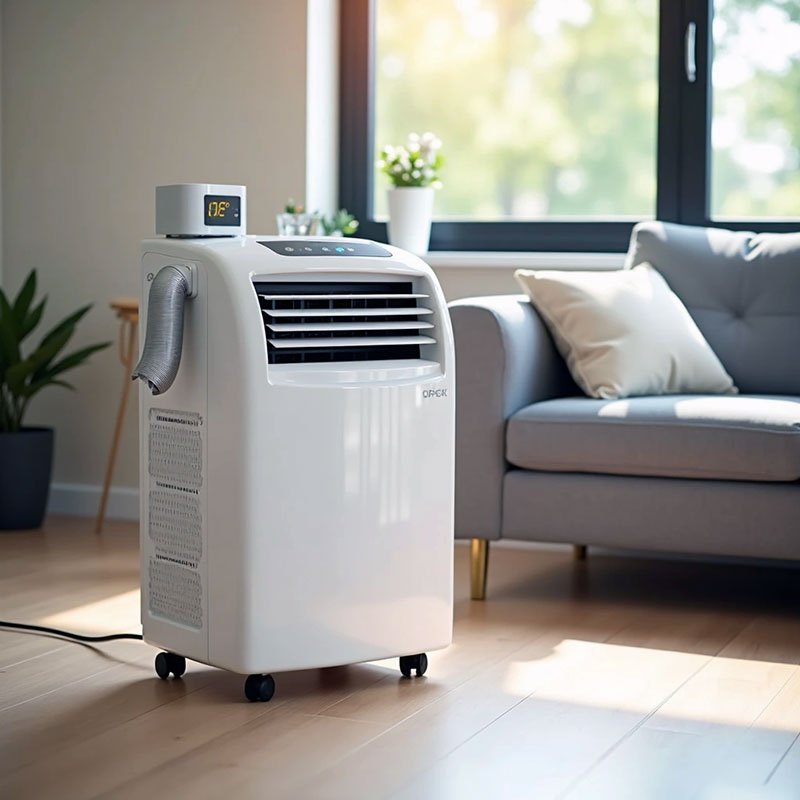
In addition to providing information on the best portable AC units overall and the highest-rated portable air conditioners for large rooms, we will also provide recommendations for the best small portable air conditioner for cramped spaces. Furthermore, we will outline what to consider when selecting the appropriate portable air conditioner for your personal use.
Top-rated portable air conditioners (2026)
We performed extensive hands-on evaluations of numerous portable air conditioners in Florida’s extreme temperatures to identify the top-performing models in each of the following categories:
Top overall portable air conditioner
Midea duo map14s1tbl earned the top rating due to its unique dual-hose design and inverter compressor technology. This 12,000-BTU unit cooled a 550-sq-ft test room faster than all other models tested. The unit operated at a significantly lower noise level than most competing units; in fact, it produced ice-cold air and operated between 42 and 49 decibels.
Best budget portable air conditioner
Lg LP0621WSR showed us that affordability does not necessarily equate to ineffectiveness. Despite being designed for rooms up to 250 square feet, it successfully cooled a 550-square-foot test room by more than 2 degrees after a 2-hour cooling cycle. As such, it offers a middle ground in pricing and performance for smaller rooms at a fraction of the cost of premium models.
Best portable AC unit for large rooms
Whynter Arc-14s stood out as the best portable air conditioner for larger rooms. At 14,000 BTU output, it reduced the room temperature by 3.6 degrees over a 2-hour cooling cycle in a 550-square-foot test room. Its dual-hose design allows it to cool more effectively than single-hose designs and is narrower than other models, conserving floor space. On average, it produces Noise levels ranging between 50 and 52 decibels.
Best dual-hose portable air conditioner
Whynter Arc-14s also took first place for its dual-air exchange process. Single-hose systems extract interior air to cool internal components, then vent the heated air externally. However, negative air pressure develops due to the extraction of interior air, causing warmed air to enter the room through cracks around windows and doors. Dual-hose systems extract cooler exterior air internally and eject warmer air externally, preventing this issue. While they may initially seem more complicated, dual-hose systems are generally more efficient at cooling larger areas and use less energy. Additionally, since dual-hose systems draw cooler external air into the system, they tend to extend filter life by continuously supplying clean, dry air. However, they do typically cost more than single-hose systems and may be heavier, making them less mobile from room to room.
Quietest portable air conditioner
LG dual inverter LP1419IVSM operates between 49 and 51 decibels and offers a 14,000 BTU cooling capacity without generating significant Noise. On high setting, it measures only 53 decibels, which is quieter than typical everyday conversations. Another model worthy of recognition is the Friedrich ZoneAire, which reaches 53 decibels on high settings as well. Both of these units incorporate inverter technology, allowing them to adjust compressor speeds rather than running at constant speeds, resulting in smoother and quieter operation.
Best small portable air conditioner
The Costway portable air conditioner fits perfectly in cramped spaces without losing any performance. It is among the lightest units we tested, weighing only 45 pounds. Dimensions of 12.5 x 12 x 27.5 inches fit in smaller spaces like bedrooms and dorms. Although it only has a 10,000 BTU cooling capacity, it can effectively cool spaces up to 350 square feet. Additionally, setup requires only minutes, and Four casters make moving it between rooms easy.
Technical specifications that determine cooling capacity and portability.
When choosing a portable air conditioner, knowing the technical specifications helps you decide whether you’ll purchase an effective cooling product or simply waste money on a paperweight.
Btu and cooling capacity:
British Thermal Units measure the amount of heat an air conditioner can remove from your home in an hour. Typically, a basic rule of thumb is that an air conditioner needs 20 BTUs per square foot of living space. Therefore, a room that is 12 feet wide and 15 feet long would have an area of 180 square feet. If your ceiling height exceeds 8 feet above the floor, add 10% more BTUs for each additional foot of ceiling height. Sunny locations increase BTU requirements by 10%, while shaded areas decrease BTU requirements by 10%. For every regular occupant who spends more time than usual in the room where you want to install the portable air conditioner, add 600 BTUs. Lastly, kitchens require 4000 BTUs more than any other location in your home.
Beyond square footage – room characteristics matter.
While room size is important for determining cooling requirements, room characteristics extend beyond square footage. High ceilings create greater heating/cooling requirements than low ceilings, regardless of room size. Larger windows present similar challenges to high ceilings. Installing an oversized unit will rapidly drop the temperature in a room before the unit has removed sufficient moisture, leaving occupants feeling damp/moist instead of cool. Conversely, installing an undersized unit results in continuous operation and inefficient cooling of the room. Continuous operation leads to wasted energy and increased risk of equipment failure.
Single-hose vs dual-hose design
Single-hose models draw interior air into the unit to cool it before exhausting the same air back outside your home. This action creates negative air pressure within your home, forcing warm air to enter through any gaps around windows and/or doorways. Since single-hose units work harder to maintain a comfortable temperature in your home, they are less efficient than their dual-hose counterparts.
Dual-hose models draw cooler outside air into the unit through one hose while expelling warm interior air through another. By doing so, dual-hose units prevent negative air pressure in your home, allowing for rapid cooling throughout. Dual-hose units consume less energy for larger rooms. Filters used by dual-hose models last longer because they consistently draw cleaner/drier outside air into the system. Unfortunately, dual-hose models cost more money initially than single-hose models and can be heavier, making them more cumbersome to transport between rooms.
Efficiency ratings – energy consumption
Energy Efficiency Ratio (EER) is defined as the ratio of an air conditioner’s cooling capacity, measured in British Thermal Units per hour (BTU/h), to its power consumption, measured in watts (W). A higher EER indicates lower electricity bills for the same amount of cooling provided by a given unit. The combined Energy Efficiency Ratio (CEER) accounts for both active cooling and standby power consumption, providing a more complete representation of a portable unit’s total energy usage. While most portable air conditioners fall within a CEER range of 6.8–7.3, top performers achieve CEER values exceeding 10.8.
Decibel levels – Noise generation
Typical portable air conditioners produce decibel levels ranging from 50 to 60 decibels, depending on fan speed. Fifty decibels represent average conversational volumes. Any portable unit producing Noise levels below fifty decibels qualifies as an option for bedroom placement. The type of compressor used in an air conditioner affects noise generation. Inverter-based or variable-speed compressors generate less Noise and are inherently more energy-efficient than fixed-speed compressors. Fixed-speed compressors exhibit loud “on/off” cycling patterns, whereas inverter-based or variable-speed compressors do not experience this pattern.
Controls & Smart features
App-controlled, WiFi-enabled units support automatic operation schedules that optimize energy use by turning off the unit when not needed. Voice control features via Amazon Alexa or Google Assistant enhance user convenience, although they do not affect cooling efficacy.
Determining what will work best based upon your specific needs & space requirements
Choosing the right portable air conditioner depends on matching your space-specific requirements with those offered by various manufacturers.
Measuring your room size:
Begin by measuring your desired room’s length and width in feet, then multiplying them to obtain the square footage of the space. For example, if your desired room measures 12 feet by 15 feet, it would be approximately 1800 square feet. Not only does room size determine cooling requirements, but ceiling height also plays a role in determining your needs. For every additional foot above 8 feet in ceiling height, you require 10% more BTUs than previously calculated.
Sun exposure impacts cooling requirements:
Sun exposure affects your space and determines whether you require more or fewer BTUs than specified earlier. Heavily shaded areas require 10% fewer BTUs; sunny areas require 10% more BTUs.
Human occupancy impacts cooling requirements:
For every additional regular occupant spending more time than usual in the space where you plan to install your portable air conditioner, increase the BTU requirement by 600 BTUs.
Window compatibility affects installation:
Compatibility with your windows presents more issues than most realize when considering a portable air conditioner. Sliding windows come equipped with standard installation kits compatible with most standard sliding windows; however, if you possess casement windows requiring cranking open to ventilate, you will necessitate special solutions, including venting panels specifically manufactured for casement windows or window inserts consisting of corrugated plastic or acrylic panels installed via either glazer push point or clear adhesive tape within five to ten minutes. Most exhaust hoses have a maximum length of six feet; therefore, you must locate the unit near a window as close as possible to minimize efficiency loss.
Options for drainage you should know about:
Modern self-evaporative units release condensed water vapor through the exhaust hose whenever relative humidity remains below ninety percent during normal operation; older units feature built-in water reservoirs that require manual draining often multiple times daily when located in humid climates; continuous drain options do exist for humid climates but modern self-evaporation units eliminate this headache altogether; check water tank regardless of self-evaporation technology as excess condensate can accumulate quickly during extremely humid weather.
Portability needs that must be considered:
If you plan to relocate the unit between rooms frequently, weight becomes relevant, as most portable air conditioners weigh anywhere from fifty to eighty pounds,, and features such as wheels/handles become critical considerations for mobility and storage. Caster sets enable single-user relocation between rooms or seasons.
Floor space requirements vary between models:
Be certain to assess potential floor space available for the new unit prior to purchasing; potential floor space available for the new unit includes clearance around vents, plus potential clearance for exhaust hose extension without kinking.
Portable Air Conditioners | Blog Article | Hannahs Heating and Air, LLC | All Rights Reserved | Inman SC