
How do you decide which AC size fits best for you? Choosing the right AC size for installation or replacement is a big decision. Residential air conditioners range in tonnage from 1.5 to 5 tons, with BTU ratings from 18,000 to 60,000. Most common residential air conditioners have SEER ratings between fourteen and sixteen. If you pick the wrong-sized AC unit, it will be impossible to remain comfortable, and you will end up paying high energy costs. If the AC unit is oversized, it will cool your house very quickly, but it won’t remove much humidity. On the other hand, if your AC unit is undersized, it will never meet your comfort needs. This blog article explains how to choose an appropriate air conditioning size by using an air conditioning unit size chart, calculating your house’s square footage, and discussing several ways professionals determine sizing.
Why ac unit Size Matters for your Home
If you pick the wrong size of air conditioning system for your Home, it could cause problems with both comfort and energy costs. On average, air conditioning makes up 13% of total household energy expenditures. In some hot and humid climates, this percentage rises to greater than 20%. Thus, the selection of air conditioning system size determines how much you pay for cooling and how comfortably your Home will feel.
Problems with an undersized air conditioner
You get no satisfaction out of a poorly sized air conditioning system. It runs continuously and never reaches your target temperature. The system runs hard trying to meet your thermostat settings, but it does not have enough cooling ability to meet those targets. The continuous operation of the air conditioner never cools your house and puts tremendous stress on its various components.
With many systems properly sized, they will cool your Home by approximately twenty degrees below the exterior ambient temperature. If the unit continues to run without shutting down, there is either insufficient capacity for your square footage or insufficient insulation for your requirements. Continuous operation of the unit will reduce the life expectancy of the compressor and fan motor. Frequent repairs become necessary; therefore, the unit’s overall lifespan shortens.
Continuous operation of the unit increases energy use and raises your utility bill. The unit uses more electricity to try to meet an unattainable temperature. Undersized units do not handle pushing cold air through duct systems located in larger homes very well. As a result of this poor handling technique, cooling is not evenly distributed throughout your Home.
Problems associated with an oversized AC unit
Oversized air conditioning systems cause frustrating issues through a phenomenon known as “short cycling.” An oversized air conditioning system cools your Home too quickly and shuts off before completing proper cooling cycles. Air conditioners lose efficiency initially at start-up. However, once started, efficiency increases rapidly, reaching optimal performance within ten minutes.
An oversized air conditioning system shuts off after 5 to 10 minutes of operation. Therefore, it prevents itself from performing at maximum efficiency. Without prolonged operation time, the system cannot remove sufficient humidity from the air. Air conditioning systems require extended runtime for moisture to condense on the coils and drain from the system. Moisture evaporates back into the air due to inadequate runtime, creating a cold yet clammy indoor atmosphere that encourages mold and mildew development.
Short on-off cycles increase wear on the compressor and fan motor. More energy is required to initiate each startup cycle, resulting in higher utility bills despite reduced runtime.
Benefits of correctly sizing your air conditioning system
A properly sized system distributes conditioned air at a lower rate for longer intervals than an oversized system. This allows cooler air to gradually blend into the space, eliminates cold drafts adjacent to supply registers, and improves dehumidification. A properly sized system maintains a consistent level of comfort throughout your Home and operates at maximum efficiency. Smaller compressors and fans result in lower indoor and outdoor noise when the system is operational.
Common types of residential air conditioning systems and their effect on sizing requirements
Before deciding which AC unit size I need for my house, I need to know the different configurations available and how they will affect my sizing requirements.
Split-system central air conditioning systems
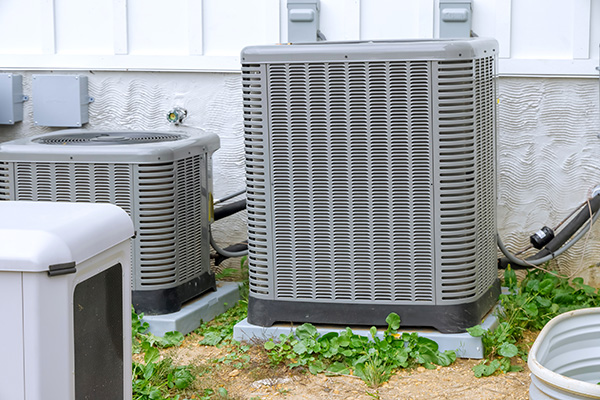
Split systems separate the components into two individual units. The indoor component includes an evaporator coil, blower wheel, and controls. The outdoor component contains a condenser coil, fan, and compressor. Refrigerant tubes connect these two units, delivering cooled air to your Home via your existing ductwork, with supply and return registers installed in each room.
Split systems account for approximately 85% of all residential installations and remain the most common type of system to install if you already have ductwork in place and want whole-house cooling. Central air systems deliver balanced temperatures throughout your Home with components located outside, providing a nearly invisible, quiet system.
Ductless mini-split systems
Mini-split systems function without ductwork. A single outdoor compressor is connected to one or multiple indoor air handlers mounted on walls or ceilings. Thin conduit housing power cables, refrigerant tubing, and condensate drains run through three-inch holes in the walls connecting these two units.
Mini-split systems excel in homes lacking existing ductwork, older structures where installing ducts becomes impractical, and/or room additions. Since mini-split systems eliminate duct-related energy losses (which typically exceed 30%), you can achieve zone control and adjust temperatures independently in each room.
Packaged air conditioning systems
Packaged air conditioning systems combine all heating and cooling components into a single outdoor cabinet. Unlike split systems, packaged units incorporate a compressor, coils, and air handlers into a single package.
Approximately 10-15% of homes in warmer climates use packaged systems due to limited space for indoor equipment.
Determining which type of system is best suited for your Home
Most factors involved in selecting a suitable system for your residence are determined by the existing infrastructure. Split-system central air conditioning is best suited for homes utilizing existing ductwork. For homeowners who lack existing ductwork, consider mini-splits in lieu of costly ductwork installation, which typically exceeds $18,000. Packaged systems suit homes that lack sufficient space to locate indoor equipment.
Calculating what Size AC unit you will require
Simple square footage Calculation method
To obtain a basic approximation, calculate your Home’s square footage multiplied by 20 BTUs. By way of illustration, a 1400 sq. The Ft Home is estimated to require approximately 28,000 BTUs. Note that this Calculation has been modified over recent years due to advancements made in modern construction materials. Prior to recent changes, the typical rule of thumb for estimating the needed BTUs was 600 sq. Ft./ton for existing homes, whereas newer homes constructed with advanced insulation materials may require closer approximations of 1000 sq. Ft./ton.
Ac size table based upon Home dimensions
For example, a 1000 sq. Ft. Home requires 2 tons (24000 BTUs) while a 1500 sq. Ft Home requires 3 tons (36000 BTUs). A 2000 sq. Ft Home requires 4 tons (48,000 BTUs) and a 2,500 sq. Ft Home requires 5 tons (60000 BTUs).
Understanding BTU & tonnage ratings
Btu stands for British thermal unit, representing the quantity of heat required to elevate one pound of water by one degree Fahrenheit. One ton represents 12,000 BTUs of cooling capacity. AC units are produced in half-ton increments, ranging from 1.5 tons to 5.5 tons, including intermediate capacities such as 2.5 tons and 3.5 tons.
Using manual J load calculations for your AC sizing needs
Manual J is recognized nationally as the standard procedure for developing HVAC equipment loading calculations. Local building codes now require compliance with Manual J standards. When performing a manual J load calculation, factors considered include insulation characteristics, window orientation, duct characteristics, Ceiling height, and local weather data.
Additional factors influencing AC sizing needs
When determining which size AC unit I need for my house, factors beyond simple square footage significantly affect the sizing. Ceiling heights greatly influence sizing requirements; for each additional foot beyond standard eight-foot ceilings, add ten percent more BTUs to your initial Calculation. Poor insulation requirements may necessitate an additional ten-to-twenty percent increase in BTUs required. Direct sunlight through large windows substantially contributes to heat gain requirements. Occupants of your home, as well as heat-producing devices (such as stoves), contribute to the overall cooling requirement.
Climate zones impacting AC sizing.
Required BTU values vary depending on your location within one of seven climate zones designated by ASHRAE (American Society of Heating, Refrigeration, and Air Conditioning Engineers). The amount of BTUs required for each climate zone is as follows: zone 1 = 30-35 BTUs/sq. Feet.; zone 2 = 35-40 BTUs/sq. Ft.; zone 3 = 40-45 BTUs/sq.ft.; zone 4 = 45-50 BTUs/sq. Ft.; zone 5 = 50-60 BTUs/sq. Additionally, you may need an additional twenty-to-thirty percent increase in required BTUs for extremely hot climates.
Understanding AC Efficiency Ratings & Specifications
In addition to other methods for determining sizing needs, familiarity with efficiency ratings helps you evaluate the air conditioner size you need for future use.
What is a SEER2 rating?
SEER2 (seasonal energy efficiency ratio) represents how effectively your air conditioner cools throughout an entire cooling season. SEER2 evaluates total cooling output against total energy use by dividing the former by the latter. Larger numbers represent greater efficiency than smaller numbers. SEER2 replaced the older SEER rating on January 1st, 2023. New testing procedures developed for SEER2 evaluations capture energy losses experienced during cycling (when turning on/off) that were not accounted for by SEER evaluations.
SEER2 evaluations simulate realistic airflow resistance conditions and account for losses due to operational inefficiencies (e.g., cycling). A fourteen SEER2-rated unit performs more efficiently than a comparable fourteen SEER-rated unit under identical operating conditions. Testing conducted according to SEER2 procedures captures energy loss that is not represented in SEER tests. American Standard manufactures products with SEER2 ratings ranging from thirteen SEER2 to twenty-three-point-six SEER2 (for high-efficiency models).
How do tonnage ratings work?
One ton equals 12,000 BTUs of cooling capacity. You can locate your present system’s tonnage rating on the information plate attached to your outdoor unit. Look for an even number between 18 and 60 in your model number designation, and divide it by 12.
Selecting among multiple cooling capability options
Residential air conditioners are manufactured with cooling capacities ranging from one-and-one-half tons to five-and-five-tenths tons, increasing in half-ton increments. Select the cooling capacity based on the results of your Manual J calculation rather than simply matching your current unit’s size.
Conclusion
Correctly sizing your AC affects comfort and energy costs while enhancing the system’s durability. Determining correct sizing goes beyond merely referencing an ac Size Chart based upon square footage, as illustrated above. Other factors, including climate zone, insulation quality, Ceiling height, and window exposure, also factor into sizing needs. While the charts referenced above provide a good starting point, we suggest hiring a professional to conduct a Manual J load Calculation that accurately determines proper sizing based on specific factors unique to your residence, ensuring a properly sized system that delivers reliable year-round cooling.
How Large of an AC Should I Get? | Blog Article | Hannah’s Heating and Air, LLC | All Rights Reserved | Inman SC